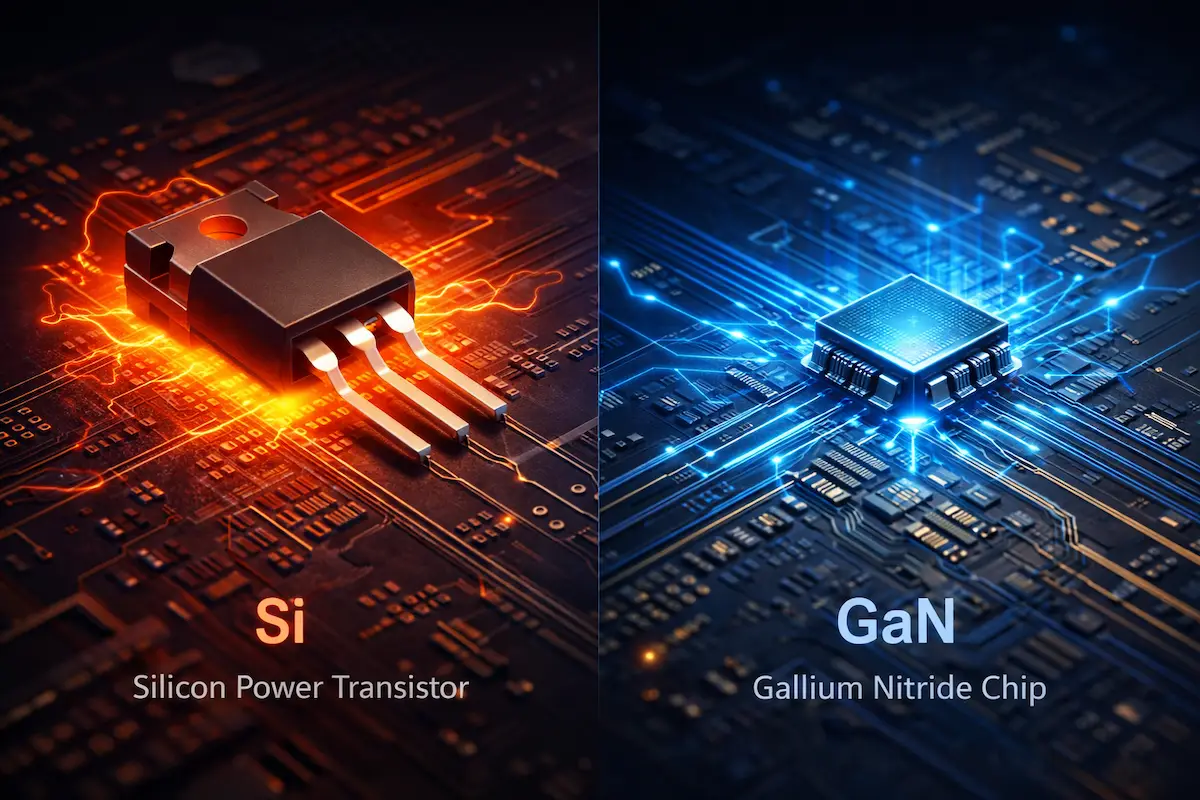
For more than 60 years, Silicon (Si) has been the undisputed king of the semiconductor world. It powered the first computers, the first smartphones, and the first electric vehicles. However, as we push for faster charging, smaller devices, and higher efficiency, Silicon is hitting its physical limits.
Enter Gallium Nitride (GaN)—the “Wide Bandgap” semiconductor that is currently disrupting the power electronics industry. From ultra-compact MacBook chargers to high-performance EV inverters, GaN is the future. At MasterWebTool.com, we explain why this shift matters for technology and your wallet.
[Image comparing a traditional bulky silicon charger with a modern compact GaN charger]
Silicon is a chemical element found in common sand. It became the standard for chips because it is abundant, easy to manufacture, and highly stable. For decades, it followed Moore’s Law, allowing us to fit more transistors into smaller spaces.
The Silicon Limit
The problem is that Silicon is a “narrow bandgap” material. This means that when you try to push too much power or heat through a Silicon chip, it loses efficiency. To handle high power, Silicon components must be large, requiring bulky cooling systems (heatsinks and fans).
Gallium Nitride is a binary III/V direct bandgap semiconductor. Unlike Silicon, GaN is a Wide Bandgap (WBG) material. This allows it to handle much higher voltages and temperatures without breaking down.
The “Wide Bandgap” Advantage
In simple terms, electrons in GaN can move much faster than in Silicon. This leads to three major benefits:
Higher Efficiency: Less energy is wasted as heat.
Faster Switching: GaN can switch ON and OFF millions of times per second, which is essential for fast charging.
Miniaturization: Because it generates less heat, we can pack the components closer together, making chargers 50% smaller.
3. The Comparison: Silicon vs. GaN
Feature
Silicon (Si)
Gallium Nitride (GaN)
Bandgap
1.1 eV (Narrow)
3.4 eV (Wide)
Efficiency
Moderate
Very High
Heat Generation
High (Requires bulky cooling)
Low (Runs cool)
Switching Speed
Standard
Lightning Fast
Cost
Low (Mass produced)
Higher (New technology)
Best For
Processors, Low-cost tech
Fast Chargers, EVs, 5G
4. Why Fast Charging Needs GaN?
If you have bought a high-wattage charger (65W, 100W, or 140W) recently, you probably noticed it is surprisingly small. That is the power of GaN.
In a traditional Silicon charger, high wattage means massive heat. To prevent melting, manufacturers had to use large components. GaN allows for High-Power Density. This means you can charge your laptop, phone, and tablet simultaneously from a brick that fits in your palm.
5. Beyond Chargers: The Impact on Electric Vehicles (EVs)
GaN isn’t just for charging your phone. In Electric Vehicles, GaN chips are used in “Inverters” that convert battery power for the motor.
Better Range: Higher efficiency means the car can go further on a single charge.
Faster Charging: GaN-based EV chargers can cut charging times significantly.
Lower Weight: Smaller cooling systems mean a lighter car.
💡 Financial Strategy: Innovation in the EV and Chip sectors is a massive investment opportunity. To see how tech investments can grow your wealth over decades, check our
.
6. The Cost Barrier: Is GaN Expensive?
Currently, GaN chips are more expensive to produce than Silicon. However, the System Cost is often lower. Because GaN allows you to remove expensive cooling components and use smaller housings, the total cost of the final product is becoming competitive.
As production scales in 2026 and beyond, we expect GaN to replace Silicon in almost all power-related applications.7. The Future of 5G and Aerospace
GaN is a hero in the world of 5G Base Stations. 5G requires high-frequency signals that Silicon simply cannot handle efficiently. GaN chips allow 5G towers to transmit data faster while consuming less electricity. In space exploration, GaN’s “Radiation Hardness” makes it perfect for satellites and spacecraft.
Silicon will still be used for CPUs and Memory for a long time, but for Power Management, the king is dead. Long live Gallium Nitride. As we move toward a more sustainable and fast-paced future, GaN chips will be the silent engines of our evolution.
At MasterWebTool.com, we stay on the cutting edge of tech so you can make informed decisions—both in your gadgets and your investments.