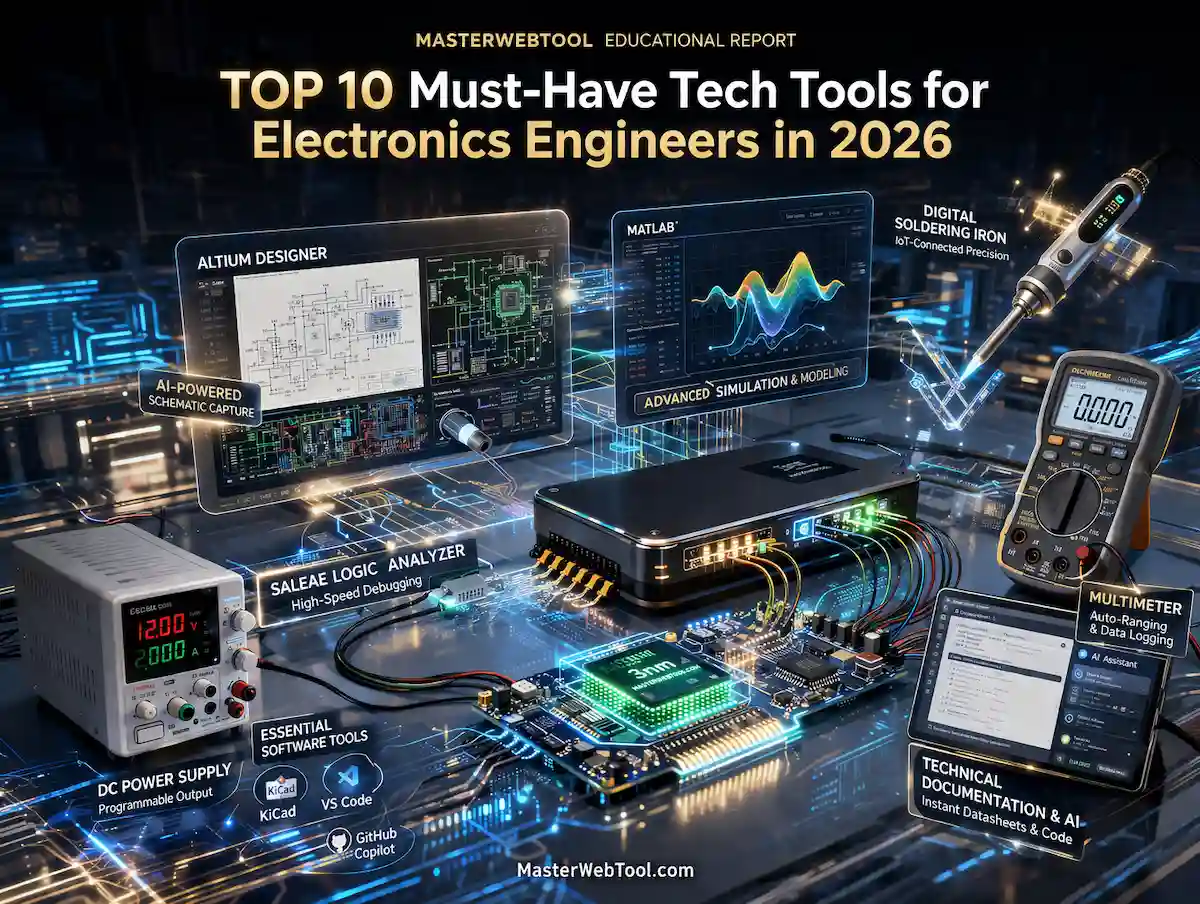
Introduction: The world of electronics is moving faster than ever. With India’s semiconductor mission in full swing and the rise of AI-driven hardware, an engineer is only as good as their toolkit. Whether you are designing circuits for the next generation of 3nm chips or working on IoT prototypes, having the right software and hardware tools is non-negotiable.
In this deep-dive guide, MasterWebTool explores the top 10 tech tools that every electronics engineer needs to master in 2026 to stay ahead in the global tech race.
1. Altium Designer: The Gold Standard for PCB Design
When it comes to Printed Circuit Board (PCB) design, Altium Designer remains the undisputed leader.
Why it’s essential: It offers a unified environment for schematic capture, PCB layout, and FPGA design.
2026 Update: The new AI-assisted routing feature helps engineers optimize trace paths in half the time.
MasterWebTool Tip: If you’re just starting, Altium’s cloud integration makes collaborating on complex projects seamless.
2. MATLAB & Simulink: For Complex System Modeling
From signal processing to control systems, MATLAB is the brain of electronics engineering.
Core Use: Engineers use it to analyze data, develop algorithms, and create mathematical models.
Simulink: This add-on allows for model-based design, which is critical when testing how circuits will perform in real-world AI environments, like those discussed at the India AI Impact Summit 2026.
3. LTspice: High-Performance SPICE Simulation
Before a single component is soldered, it must be simulated. LTspice by Analog Devices is a free, powerful, and fast simulator.
Key Benefit: It handles complex switching regulator simulations much faster than traditional SPICE tools.
Why it matters: In the age of Silicon Chip Manufacturing, simulating power integrity is the difference between a working chip and a costly failure.
4. KiCad: The Open-Source Powerhouse
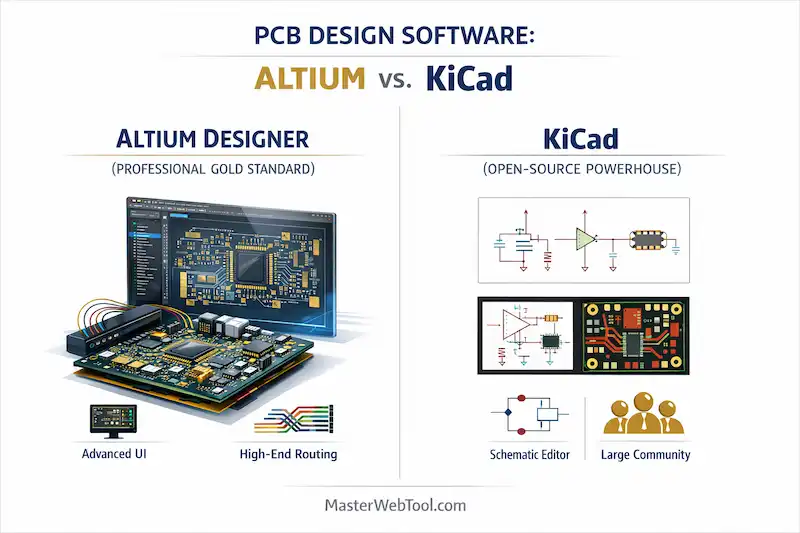
Professional vs. Open-Source: Choosing between the high-end routing of Altium and the community powerhouse KiCad.
Not every project requires a $10,000 Altium license. KiCad has evolved into a professional-grade, open-source tool for PCB design.
Features: It includes a 3D viewer, schematic editor, and a huge community-driven library.
Best for: Startups and independent researchers working on “Make in India” hardware projects.
5. Saleae Logic Analyzers: Debugging at the Speed of Light
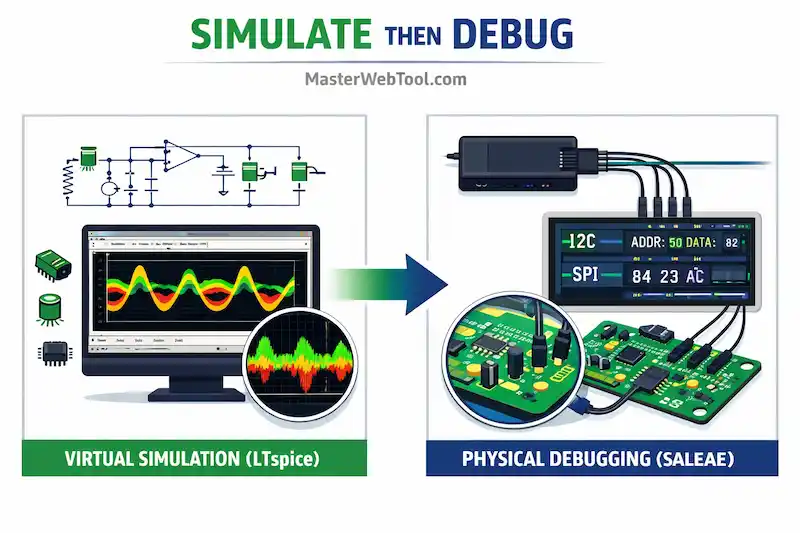
The Validation Cycle: Moving from virtual simulation in LTspice to real-world debugging with Saleae logic probes.
Hardware debugging is no longer just about multimeters. You need to see the digital signals.
Tool: Saleae Logic Pro.
Capability: It allows you to record and decode protocols like I2C, SPI, and USB in real-time. This is essential for debugging the interconnects we explained in our guide on How Silicon Chips Are Made.
6. ANSYS HFSS: For High-Frequency Electromagnetics
As we move towards 6G and advanced 5G chips, managing electromagnetic interference (EMI) is a nightmare.
The Tool: ANSYS High-Frequency Structure Simulator (HFSS).
Use Case: It is used for designing antennas and high-speed components where signal integrity is a challenge.
7. Python: The Scripting Language of Hardware
Yes, a programming language is a “tool” for modern electronics engineers.
Automation: Python is used to automate test equipment (via PyVISA), handle large datasets from sensors, and even design hardware via MyHDL.
AI Integration: For engineers working on Edge AI, Python is the bridge between hardware and machine learning models.
8. LabVIEW: System Design Software
National Instruments’ LabVIEW is a graphical programming environment used by millions of engineers to develop sophisticated measurement, test, and control systems.
Unique Feature: Its “G” programming language is intuitive for hardware-focused minds who prefer flowcharts over lines of code.
9. Cadence Virtuoso: For IC and Semiconductor Design
Since you are following the semiconductor boom, this tool is vital.
Focus: Virtuoso is used specifically for Custom IC design (Analog, Mixed-Signal, and RF).
Industry Link: This is the tool used in the “Fabs” of Dholera and Sanand to create the actual layouts of 3nm and 5nm chips.
10. MasterWebTool Image & File Converters: The Productivity Secret
Technical documentation is a huge part of an engineer’s life.
The Problem: Converting high-res circuit diagrams (PNG/TIFF) into web-friendly formats for reports.
The Solution: Using MasterWebTool’s Image Compressor and PDF Tools ensures that technical datasheets are optimized without losing a single pixel of detail.
Conclusion: Building the Future of Electronics
Being an electronics engineer in 2026 is about more than just soldering; it’s about mastering a symphony of software and hardware tools. From the initial simulation in LTspice to the final chip design in Cadence, these tools are the foundation of the digital revolution.