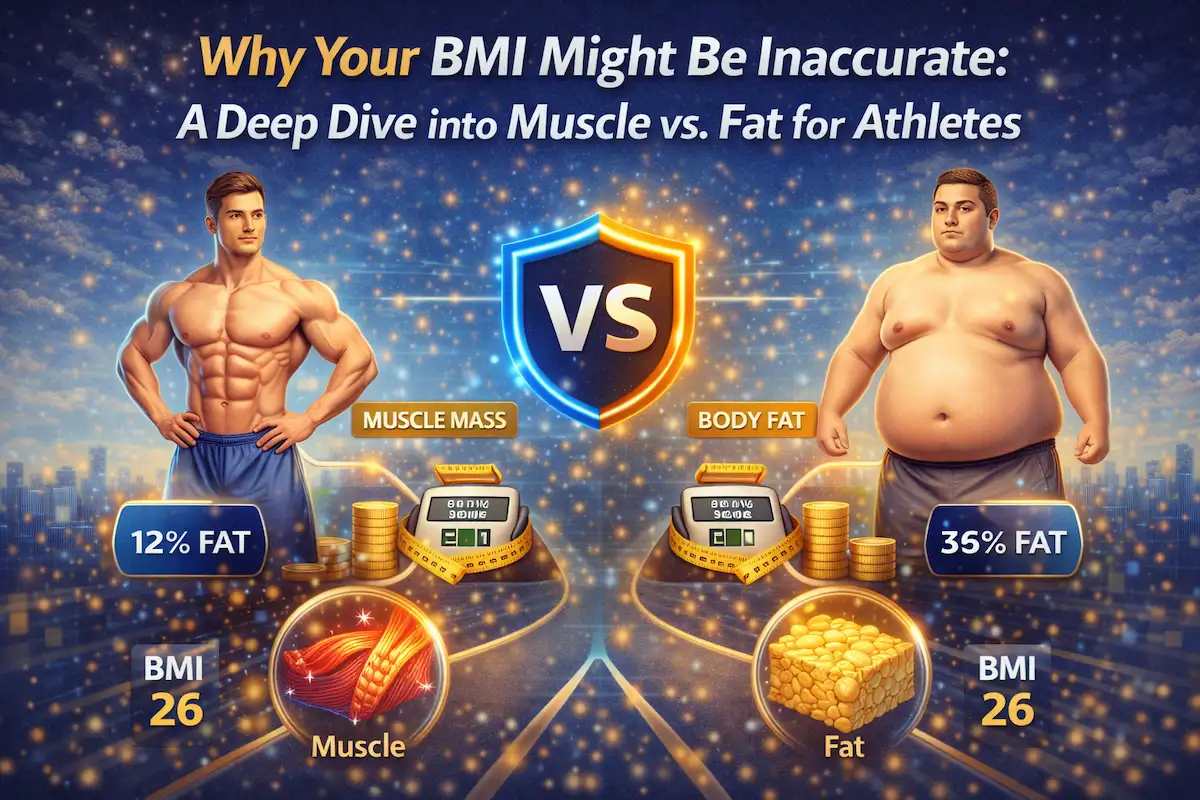
When you step on a scale, you are looking for a simple number to tell you if you are healthy or not. Most of us, and even many doctors, rely on the Body Mass Index (BMI). But when we actually sit down and look at a true BMI Comparison: Muscle vs Fat Density, we quickly realize that this traditional measurement has some massive blind spots.
I built the tools on this site to give you accurate data, but I also want you to understand how to read that data. Whether you are an endurance runner, lifting weights, or just trying to get in shape, understanding the BMI Comparison: Muscle vs Fat Density is the secret to setting realistic, stress-free fitness goals.
Before we dive into the science, go ahead and calculate your current score so you can follow along with what I’m explaining:
📊 Open My Free BMI CalculatorThe Flaw in the Formula: Why I Wanted to Explain This
At its core, BMI is just a math equation: your weight divided by your height squared. When I coded the calculator, it was easy to set up because the formula is universal. It gives us a quick baseline to see if we are underweight, normal, overweight, or obese.
But here is where the problem starts. The formula assumes that all the weight you carry is exactly the same. But as a human being, your body is much more complex. In a scientific BMI Comparison: Muscle vs Fat Density, we know that muscle tissue is incredibly dense. In fact, one kilogram of muscle takes up about 15% to 20% less space in your body than one kilogram of fat. Because muscle is so compact and heavy, it throws the BMI calculation completely off balance.
The “Muscle vs Fat” Paradox
Have you ever noticed that a professional athlete might look incredibly lean, but their BMI says they are “Overweight”? I see this all the time. Because muscle is denser, it adds heavy, metabolically active weight to your frame. You aren’t carrying harmful fat; you are carrying an engine that burns calories.
This paradox is why I always tell my users: do not let a single number ruin your day. If you are lifting weights, eating right, and your clothes are fitting better, but the scale isn’t moving—congratulations! You are replacing low-density fat with high-density muscle. Your BMI might stay the same, but your health is drastically improving.
Want to see what the basic formula says about you right now? Use my tool to get a quick baseline.
🚀 Calculate Your BMI NowHow I Recommend You Read Your Results
When you use the calculator, it will put you in one of four groups. While I programmed it to show these standard medical ranges, I want you to view them as a rough guide, not an absolute rule.
When to Actually Worry
Extremes on the scale are still valid warnings. If your score is below 18.5, you might be facing nutritional deficiencies. If your score is above 30, and you know you aren’t carrying a lot of muscle, that extra fat volume is statistically linked to higher risks of Type 2 diabetes and heart issues. That’s when the BMI tool does its job perfectly.
If you’re a geek like me and want to see the exact math and logic behind the tool, I have explained the full formula right on the calculator page:
📖 Check Out the Formula on the BMI Calculator PageMy Final Thoughts
I host this BMI calculator because it is a valuable piece of the health puzzle. It gives us a fast snapshot of where we stand. However, a proper BMI Comparison: Muscle vs Fat Density proves that your health is defined by much more than a simple ratio. Use my tools to track your progress, but always combine that data with how you feel, how you perform, and how your clothes fit.
Looking for more ways to track your health? I’ve built an entire collection of free calculators to help you hit your goals:
🏋️♂️ View All Fitness & Health ToolsCommon Questions I Get Asked
1. Is BMI accurate for older adults?
As we age, we naturally lose some of that dense muscle and gain fat. For seniors, I usually point out that a slightly higher BMI (around 23-27) is often considered healthier than being on the very low end of the scale.
2. Why doesn’t the calculator ask for my body fat percentage?
Because BMI only uses height and weight! If you want to factor in your fat percentage, you’ll need to use my Body Fat Calculator instead, which gives a much more detailed picture.