The global economy currently runs on silicon. From the smartphone in your pocket to the advanced artificial intelligence (AI) servers driving the next industrial revolution, semiconductors are the “brains” behind every piece of modern technology. As we move through 2026, the demand for high-performance chips has reached an all-time high. Identifying the top semiconductor companies in the world is no longer just for investors—it is essential for understanding how our digital future is being built.
In this comprehensive guide, we will explore the massive players dominating the market this year. We will look at the giants in chip design, the masters of manufacturing (foundries), and the companies providing the specialized equipment needed to etch circuits thinner than a human hair. By the end of this article, you will have a clear picture of who leads the industry and why their success matters to your daily life.
How the Semiconductor Industry Actually Works
Before we list the companies, you need to know that not all semiconductor firms do the same thing. The industry is highly specialized and divided into three main business models:
Fabless Companies: These companies focus entirely on research, architecture, and design. They create the complex blueprints for the chips but do not own the massive, expensive factories required to build them. Examples include NVIDIA, Qualcomm, and AMD.
Foundries (Pure-Play): These are the manufacturers. They act as a massive “printing press” for silicon. They take the designs from fabless companies and turn them into physical chips. TSMC is the undisputed king of this category.
Integrated Device Manufacturers (IDMs): These giants handle the entire process under one roof. They design their own chips and manufacture them in their own factories. Samsung and Intel are the most famous IDMs.
Understanding this ecosystem is crucial because the top semiconductor companies in the world rely heavily on each other to bring a single chip to the market.
Top Semiconductor Companies in the World by Impact and Revenue (2026)
The leaderboard has shifted significantly over the last few years. While traditional giants ruled the past decade, the explosive rise of AI has catapulted new companies to the very top.
1. NVIDIA (United States)
NVIDIA has become the heavyweight champion of the semiconductor world. Originally known for making Graphics Processing Units (GPUs) for video games, they pivoted brilliantly to become the backbone of the AI era. Their specialized chips are uniquely capable of handling the massive mathematical workloads required by artificial intelligence.
Key Focus: AI Accelerators, Gaming GPUs, Data Center infrastructure.
Market Position: They currently hold over 80% of the global AI chip market, making them one of the most valuable companies on the planet.
2. TSMC (Taiwan)
Taiwan Semiconductor Manufacturing Company (TSMC) is perhaps the most important company you’ve never seen. They don’t sell chips under their own name. Instead, they build them for Apple, NVIDIA, and AMD. They are the world’s largest dedicated foundry.
Key Focus: Advanced node manufacturing (producing chips with transistors as small as 2 nanometers).
Market Position: TSMC controls roughly 60% of the global foundry market. Their extreme precision is unmatched by almost any other manufacturer.
3. Samsung Electronics (South Korea)
Samsung is a unique beast in the tech world. They are a massive IDM that leads the world in “Memory” chips (like DRAM and NAND storage used in phones and computers). Furthermore, they run a highly advanced foundry business, acting as the primary competitor to TSMC.
Key Focus: High Bandwidth Memory (HBM) chips, Mobile processors, and Foundry services.
Market Position: The undisputed leader in global memory chip production.
4. ASML (Netherlands)
While ASML doesn’t sell chips, they are the ultimate gatekeeper of the industry. They manufacture the massive, highly complex Extreme Ultraviolet (EUV) lithography machines that print the microscopic circuits onto silicon wafers.
Why They Matter: They hold a 100% global monopoly on EUV technology. Without ASML’s machines, companies like TSMC and Intel simply cannot manufacture modern, advanced chips.
5. Broadcom (United States)
Broadcom is the quiet giant of the internet. They specialize in networking, broadband, and custom silicon chips. Whenever data moves through a large data center, a Wi-Fi router, or a 5G network, Broadcom’s technology is likely directing the traffic.
Key Focus: Data center switches, custom AI application-specific integrated circuits (ASICs), and wireless communication chips.
6. Intel (United States)
Intel was the undisputed leader of the semiconductor world for decades. While they faced manufacturing delays in recent years, their massive “IDM 2.0” strategy is revitalizing the company in 2026. They are upgrading their factories and opening them up to manufacture chips for outside clients, not just for themselves.
Key Focus: Computer Processors (CPUs) for laptops and servers, and expanding their new foundry business.
7. Qualcomm (United States)
If you own a smartphone, there is a very high chance it relies on Qualcomm technology. They dominate the market for mobile processors (the Snapdragon series) and cellular modems that allow devices to connect to 4G and 5G networks.
Key Focus: Mobile system-on-chips (SoCs), automotive chips, and wireless connectivity.
8. AMD (United States)
Advanced Micro Devices (AMD) has staged a historic and highly successful comeback over the last ten years. By designing incredibly efficient processors and utilizing TSMC for manufacturing, they have consistently captured market share from Intel in both consumer computers and enterprise data centers.
Key Focus: High-performance CPUs and GPUs for gaming, cloud computing, and enterprise servers.
To give you a clear picture of the financial landscape, here is an overview of the estimated revenue impact of these massive corporations.
| Rank | Company | Country | Primary Business Model | 2026 Market Impact |
| 1 | NVIDIA | USA | Fabless (AI/GPU) | Dominant |
| 2 | TSMC | Taiwan | Foundry (Manufacturing) | Critical/Monopoly |
| 3 | Samsung | S. Korea | IDM (Memory/Foundry) | Very High |
| 4 | Intel | USA | IDM (CPU) | High |
| 5 | Broadcom | USA | Fabless (Networking) | High |
Real-World Case Study: The Journey of an AI Chip
To truly understand why the top semiconductor companies in the world are so interconnected, let’s look at how a modern AI server gets built in 2026:
The Design Phase: A major tech company needs a new AI processor. NVIDIA spends billions of dollars and years of research to design the chip’s complex architecture.
The Equipment: To build this complex design, the manufacturer needs the right tools. ASML ships a $300 million lithography machine from Europe to Asia.
The Manufacturing: TSMC receives the design from NVIDIA and uses ASML’s machines to print billions of microscopic transistors onto silicon wafers.
The Memory: An AI chip needs lightning-fast memory to work properly. Samsung provides advanced High Bandwidth Memory (HBM) modules that are packaged alongside the processor.
The Network: Finally, once the chips are placed in a massive data center, Broadcom networking switches ensure all the servers can communicate with each other instantly.
This global supply chain demonstrates that no single company can build the future alone. They all rely on the specific expertise of others.
Related Semiconductor Insights
If you want to deepen your knowledge of how this fascinating industry operates, check out our previously published guides right here on MasterWebTool:
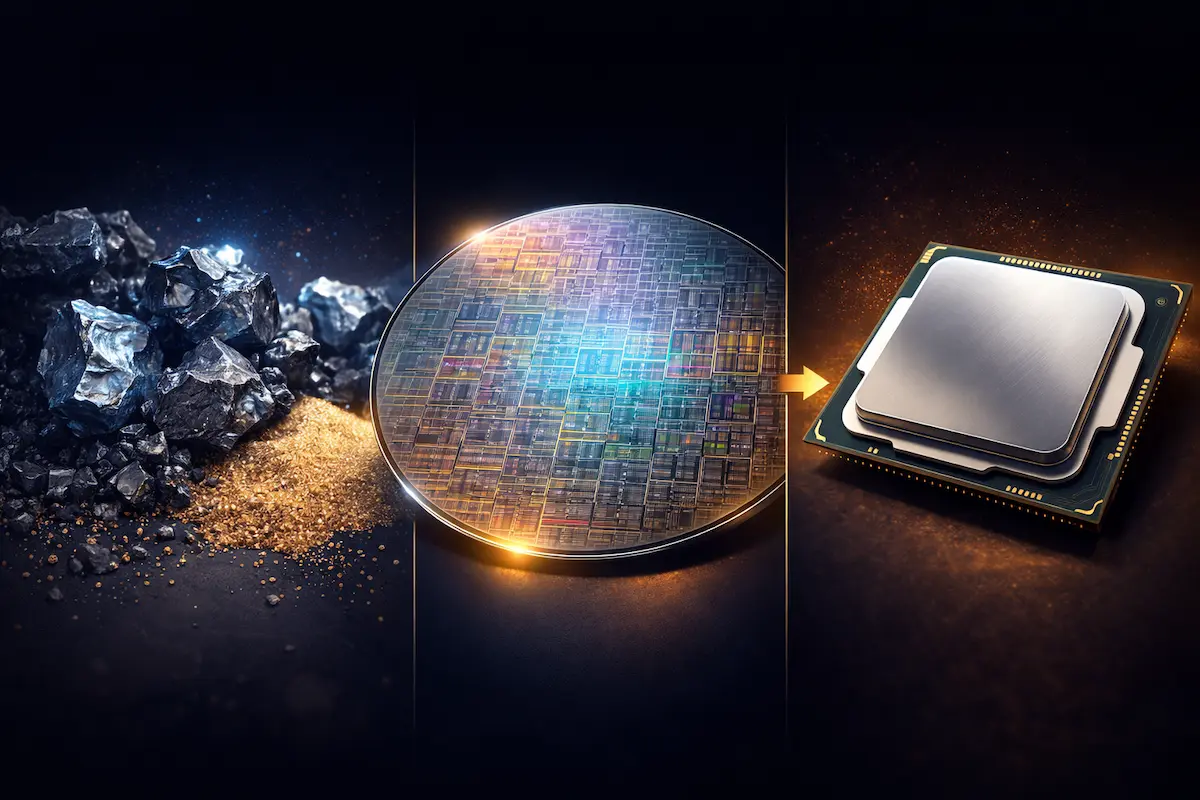
Semiconductor Manufacturing Process Explained– Dive deep into how raw sand is transformed into high-tech silicon wafers.
How Silicon Chips Are Made Step by Step]– A beginner-friendly look at the fabrication process inside a cleanroom.
What Are Semiconductor Chips and How Do They Work – The ultimate starting point to understand the physics and technology behind modern electronics.
For more general information on the science behind these materials, you can also explore the comprehensive Semiconductor entry on Wikipedia.
Frequently Asked Questions (FAQ)
1. Which company is the absolute largest semiconductor manufacturer?
When it comes to actually building the chips, TSMC (Taiwan Semiconductor Manufacturing Company) is the largest dedicated manufacturer in the world. They produce the most advanced chips globally.
2. Why is NVIDIA making so much money right now?
NVIDIA’s success is tied directly to the boom in Artificial Intelligence. Their hardware (GPUs) and specialized software platform (CUDA) are the industry standard for training advanced AI models, meaning nearly every major tech company has to buy from them.
3. What exactly is a “nanometer” in chip manufacturing?
A nanometer (nm) is a unit of measurement used to describe the size of the transistors on a chip. A smaller number (like 2nm or 3nm) means the transistors are smaller, allowing companies to pack more of them onto a single chip, which increases speed and power efficiency.
4. Are there any major semiconductor companies in India?
India is currently making massive strides to enter the manufacturing side of the industry. Companies like the Tata Group are actively building India’s first major commercial fabrication and testing facilities to secure a spot in the global supply chain.
5. What does the term “Chip Shortage” mean?
A chip shortage occurs when the global demand for electronics outpaces the foundries’ ability to manufacture the silicon. Because building a new chip factory takes years and billions of dollars, supply cannot be increased quickly during a sudden spike in demand.
Conclusion
The list of the top semiconductor companies in the world represents the very foundation of modern human progress. From the incredible AI processing power designed by NVIDIA to the unmatched manufacturing capabilities of TSMC and the critical machinery provided by ASML, these corporations dictate the pace of technological advancement.
Understanding who these companies are and how they interact gives you a massive advantage in navigating the modern economy, predicting market trends, and understanding the geopolitics of the 21st century. As technology continues to evolve toward even smaller and more efficient designs, these silicon titans will remain at the center of the global stage.