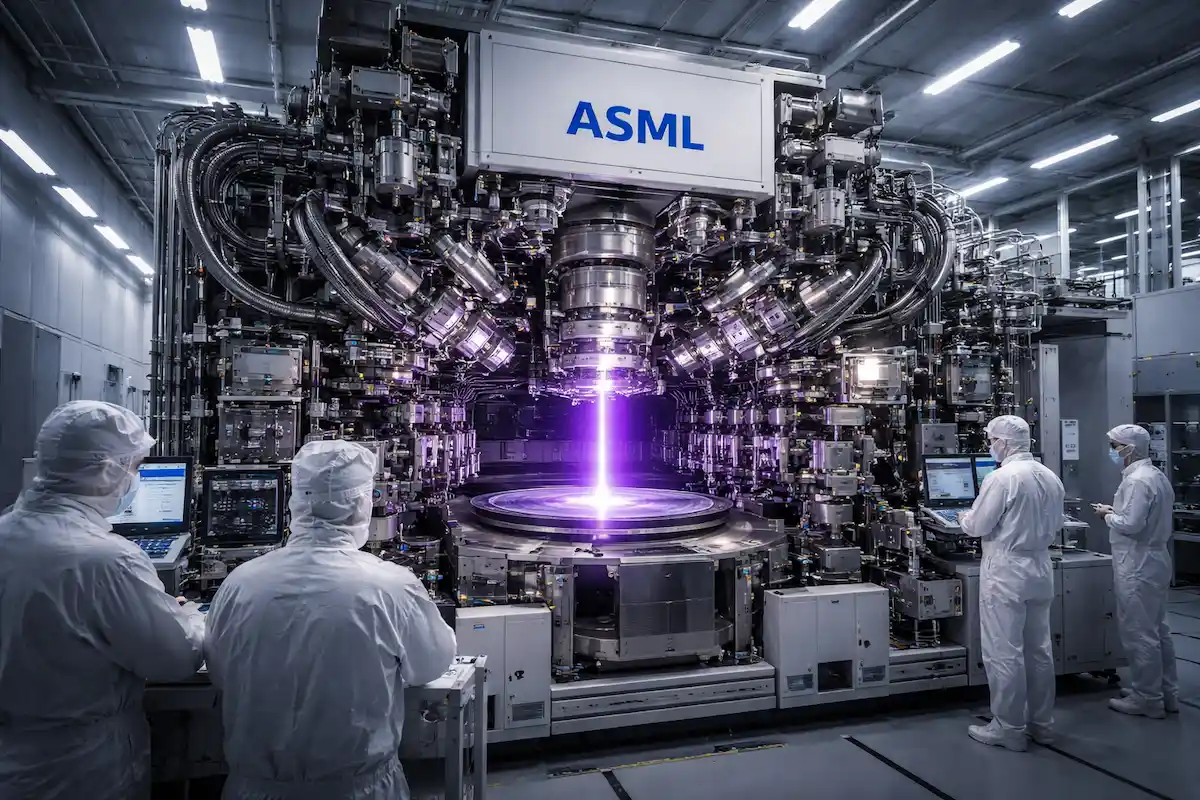
In the global “Chip War,” there is one company that holds the ultimate power. It’s not Apple, NVIDIA, or Intel. It is a Dutch company called ASML. They possess a complete monopoly over the world’s most complex piece of equipment: the EUV (Extreme Ultraviolet) Lithography machine.
Without ASML, the modern digital age would grind to a halt. At MasterWebTool.com, we explain why this $350 Million machine is the most important invention of the 21st century.
1. What is EUV Lithography? (The Science of Light)
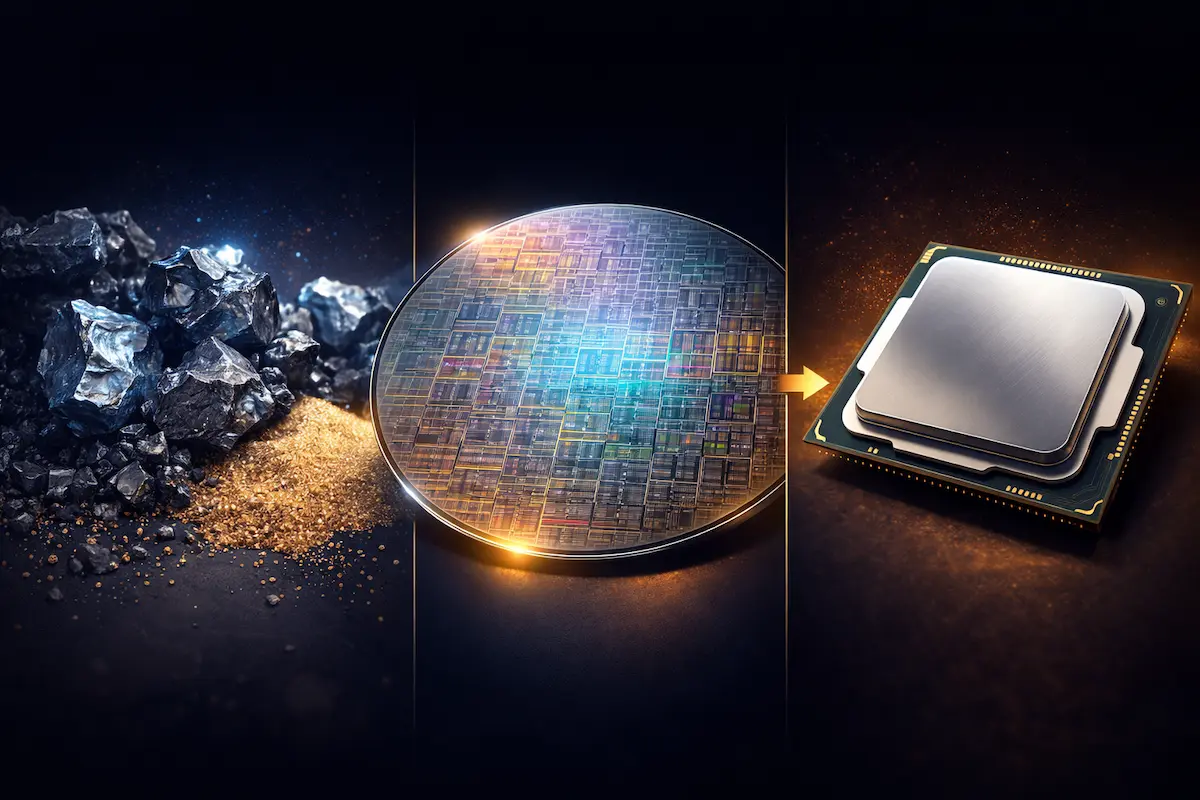
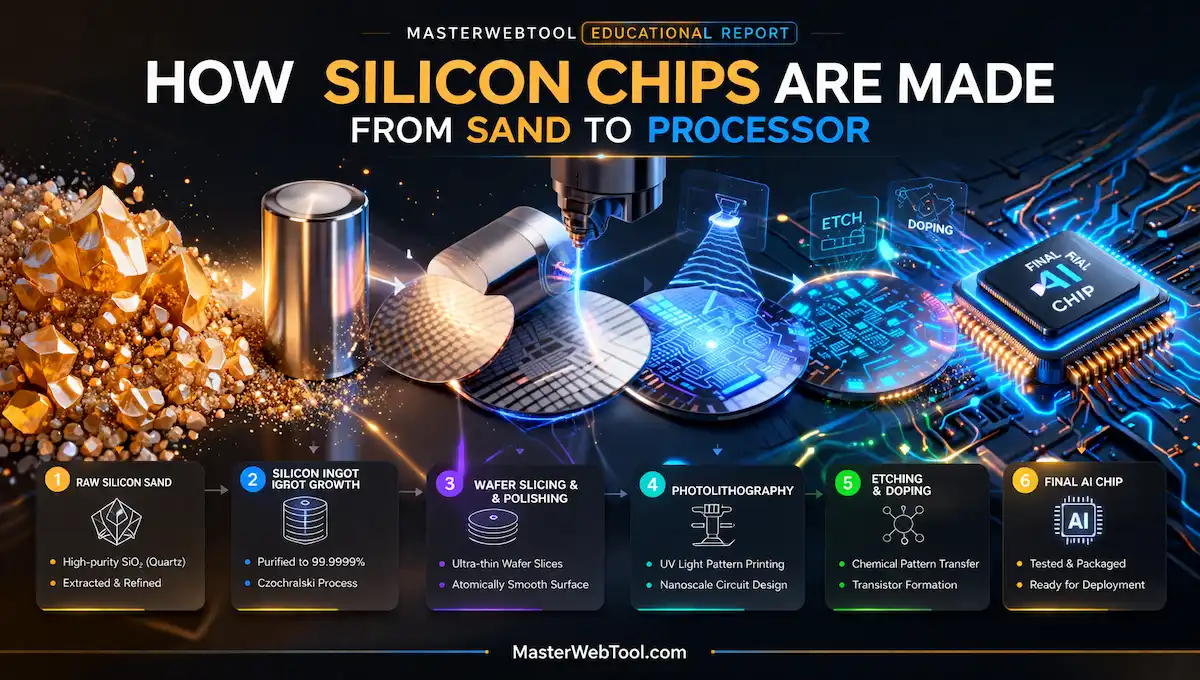
Lithography is essentially “printing with light.” To create a chip, engineers need to etch billions of tiny transistors onto a silicon wafer.
The Challenge: As transistors became smaller than the wavelength of visible light, traditional printing methods failed.
The Solution: Extreme Ultraviolet (EUV) light. It has a wavelength of just 13.5 nanometers—almost the size of an X-ray. This allows ASML to “print” features so small that they push the limits of physics.
🔗 Deep Dive: To understand how these printed transistors form the “brain” of your devices, check our foundational guide: What Are Semiconductor Chips and How Do They Work?
2. Why is ASML a Monopoly? (The $20 Billion Barrier)
ASML is the only company in the world that can build these machines. Neither Japan’s Nikon nor Canon can compete. Why?
Complexity: An EUV machine has over 100,000 parts and requires 40 freight containers to ship.
The Mirrors: Developed by Zeiss, these are the flattest surfaces on Earth. If you scaled one mirror to the size of Germany, the highest “bump” on it would be less than 1 millimeter tall.
The Light Source: To create EUV light, a laser hits a tiny drop of molten tin 50,000 times per second, creating a plasma hotter than the surface of the sun.
3. The Fact-Sheet: EUV vs. DUV Technology
Before EUV, the industry used DUV (Deep Ultraviolet). Here is how the transition changed the semiconductor landscape:
| Feature | DUV (Deep Ultraviolet) | EUV (Extreme Ultraviolet) |
| Wavelength | 193 nm | 13.5 nm |
| Resolution | Low (Requires multiple passes) | High (Single pass precision) |
| Node Support | 7nm and above | 5nm, 3nm, and 2nm |
| Machine Cost | ~$80 Million | ~$350 Million+ |
| Market Share | Competitive | 100% ASML Monopoly |
4. How ASML Influences Global Tech Inflation
Because an EUV machine costs over $350 Million, only giants like TSMC, Samsung, and Intel can afford them. This massive “Entry Barrier” is a primary reason why high-end smartphones and AI chips (like NVIDIA’s H100) are becoming so expensive.
When the cost of manufacturing infrastructure rises, it leads to tech-driven inflation. To see how these rising costs impact your long-term purchasing power, use our professional Inflation Calculator.
5. The Geopolitical “Chip War”
The US has banned ASML from exporting EUV machines to China. This single move has effectively capped China’s ability to produce the world’s most advanced 3nm chips. ASML is now at the center of a global tug-of-war between superpowers.
🔬 Tech Insight: Moving the massive amounts of data generated by these advanced chips requires a specialized highway system inside the CPU. Learn more in our article: Bus Architecture: How Data Travels Inside a CPU.
6. The Future: High-NA EUV
ASML isn’t stopping at standard EUV. They are now rolling out High-NA (Numerical Aperture) EUV machines. These $500 Million giants will allow Intel and TSMC to reach the 1nm node, bringing us closer to the physical limits of the silicon atom.
7. Conclusion: The Foundation of Digital Civilization
ASML is the invisible backbone of everything we do online. Whether you are using an Image Compressor on our site or training a massive AI model, the chips doing the work were likely birthed inside an ASML machine. Understanding this monopoly is key to understanding the future of global technology.
Frequently Asked Questions (FAQ)
Q1. Why can’t other companies just copy ASML?
ASML has spent 30 years and billions of dollars in R&D. Their supply chain involves thousands of specialized companies (like Zeiss for optics and Trumpf for lasers) that have exclusive contracts. Copying an EUV machine is like trying to build a space shuttle from scratch.
Q2. Does ASML build the chips too?
No. ASML builds the “Photolithography Machines” (the printers). They sell these machines to “Foundries” like TSMC (Taiwan) and Samsung (Korea), who then use them to manufacture the actual chips for companies like Apple and NVIDIA.
Q3. How does this affect my personal finances?
As chip manufacturing becomes more expensive, the ROI on tech stocks and the cost of consumer electronics will fluctuate. To manage your wealth in this high-tech economy, use our FIRE Calculator to stay on track for retirement.
🛠️ Related MasterWebTool Resources
FIRE Calculator – Plan your exit from the 9-to-5 grind with precision.
Image Compressor – Speed up your high-tech website instantly.
Power of Compounding – Learn how to grow your wealth like the tech giants.