In the modern digital era, there is an invisible force driving every technological advancement—from the smartphone in your pocket to the AI servers that power global networks. This force is the Semiconductor Chip. Often referred to as the “new oil,” semiconductors have become the most critical component of the 21st-century economy.
At MasterWebTool.com, we provide deep technical insights to help you stay ahead in the tech race. In this comprehensive guide, we will break down the complex science of chips into simple, actionable knowledge.
1. What is a Semiconductor? (The Core Science)
In physics, materials are generally classified into three categories based on their ability to conduct electricity:
Conductors: Materials like Copper or Gold that allow electricity to flow freely.
Insulators: Materials like Rubber or Glass that block the flow of electricity entirely.
Semiconductors: Materials like Silicon or Germanium that fall somewhere in between.
The “magic” of a semiconductor is its ability to change its conductivity. By adding tiny amounts of impurities—a process known as Doping—scientists can control exactly when and how much electricity flows through the material. This controllable “ON/OFF” state is the foundation of all digital logic (Binary: 1s and 0s).
🔗 Deep Dive: To understand the specific materials used in high-end processors, read our article on Silicon vs. Gallium Nitride: The Future of Fast Charging Chips.
2. Transistors: Billions of Microscopic Gatekeepers
Inside every high-end chip, such as an NVIDIA AI GPU or an Apple M-series processor, there are billions of microscopic switches called Transistors.
The Scale: A modern chip can hold over 50 Billion transistors on a surface no larger than a human fingernail.
The Function: These transistors act as gates. When an electrical signal hits the gate, it opens or closes, processing bits of data at the speed of light.
📖 Read More: How do these transistors communicate? Explore our detailed guide on Bus Architecture: How Data Travels Inside a CPU.
3. The Manufacturing Process: A Feat of Engineering
Producing a semiconductor chip is arguably the most complex manufacturing process ever achieved by humanity. It takes place in “Clean Rooms” where the air is 10,000 times purer than a hospital operating room.
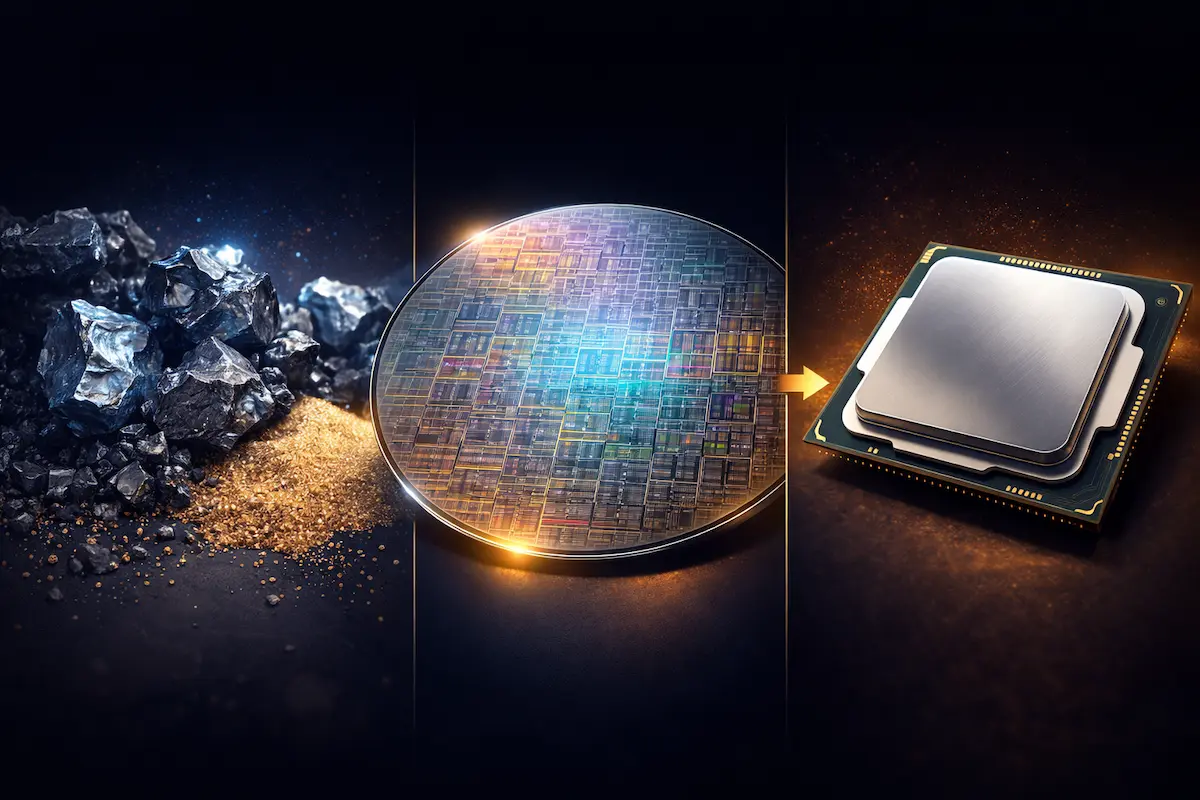
Ingot Slicing: Pure silicon is grown into large cylinders (Ingots) and sliced into paper-thin disks called Wafers.
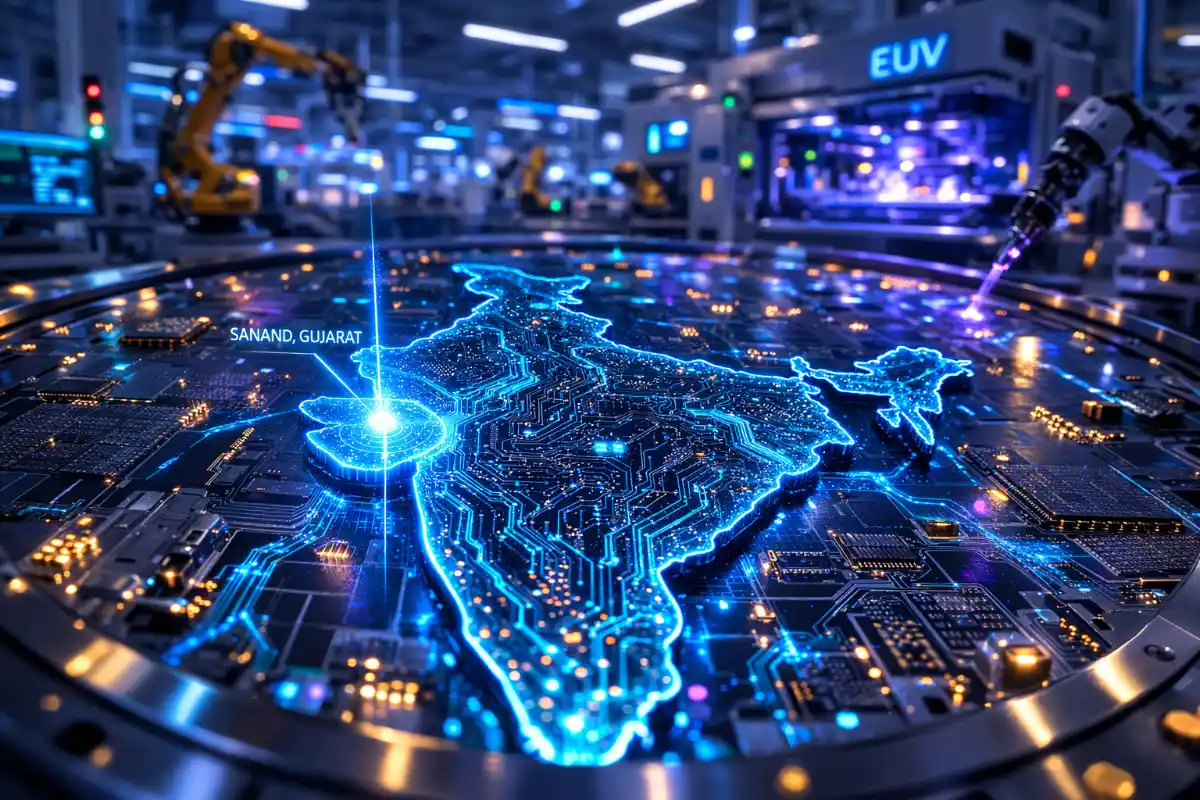
Photolithography: Machines (like those from ASML) use Extreme Ultraviolet (EUV) light to “print” incredibly complex circuit designs onto the wafer.
Etching & Deposition: Chemicals are used to carve out the printed design and deposit layers of metal to connect the transistors.
🔬 Tech Insight: If you want to know more about the machines that build these chips, check out ASML and the Monopoly of EUV Lithography.
4. Why the World is Fighting “Chip Wars”?
Semiconductors are now the backbone of national security and economic growth. From 5G telecommunications to stealth fighters, everything depends on advanced silicon. This has led to a global race between the US, China, and Europe to dominate the manufacturing landscape.
The Impact of Chip Shortages
When the supply of chips is disrupted, the production of cars and gadgets slows down, leading to price hikes. This is a primary driver of modern tech-driven inflation.
5. The Future: 2nm Chips and Quantum Computing
As transistors approach the size of a single atom, the industry is moving toward new frontiers:
2nm Fabrication: Creating circuits so small that they push the boundaries of quantum physics.
Quantum Chips: Moving beyond 1s and 0s to “Qubits,” allowing near-infinite processing speed.
🛠️ Related Financial Planning (MasterWebTool Special)
While understanding technology is crucial, managing the wealth generated by the tech era is equally important. Use our specialized calculators to stay financially independent:
FIRE Calculator – Plan your early retirement in the tech-heavy world.
Inflation Calculator – Adjust your savings for rising tech costs.
Power of Compounding – See your investments grow exponentially.