Look around you right now. Whether you are reading this on a smartphone, a laptop, or a tablet, you are holding a miracle of modern engineering. All of these devices share one hidden secret: they rely entirely on microscopic pieces of silicon. If you have ever wondered how semiconductor chips power modern electronics, you are about to discover the fascinating science behind the digital age.
Semiconductor chips, often just called microchips or integrated circuits, are the “brains” of nearly every electronic device we use today. From the alarm clock that wakes you up to the massive data centers running artificial intelligence, these tiny components dictate how our world operates.
In this comprehensive guide, we will break down the complex science of semiconductors into simple, easy-to-understand concepts. We will explore what they are made of, how they process information, and why the global economy is so dependent on them.
What Exactly is a Semiconductor?
To understand how semiconductor chips power modern electronics, we first need to understand the material itself.
In the world of physics, materials are generally divided into two categories when it comes to electricity:
Conductors: Materials that let electricity flow easily (like copper or gold).
Insulators: Materials that block electricity (like rubber, glass, or plastic).
A semiconductor sits right in the middle. Under normal conditions, it acts like an insulator. But if you add heat, light, or specific chemical impurities (a process called “doping”), it suddenly becomes a conductor. This unique ability to switch between blocking and allowing electricity to flow is the foundational secret of all modern computing.
The most common material used to make these chips is Silicon, which is extracted from ordinary sand.
The Heart of the Chip: The Transistor
If the semiconductor chip is the brain, the transistor is the brain cell.
A transistor is an incredibly tiny electronic switch. Because a semiconductor can control the flow of electricity, a transistor uses this property to turn an electrical current “ON” or “OFF.”
The Language of Computers: 1s and 0s
Computers do not understand English, Hindi, or any human language. They only understand binary code: a series of 1s and 0s.
When the transistor allows electricity to pass (ON), the computer reads it as a “1”.
When the transistor blocks the electricity (OFF), the computer reads it as a “0”.
By combining billions of these tiny switches on a single chip, a computer can process complex math, display high-resolution graphics, and connect to the internet. Today, companies can fit over 50 billion transistors onto a single chip no larger than a postage stamp!
How Semiconductor Chips Power Modern Electronics in Daily Life
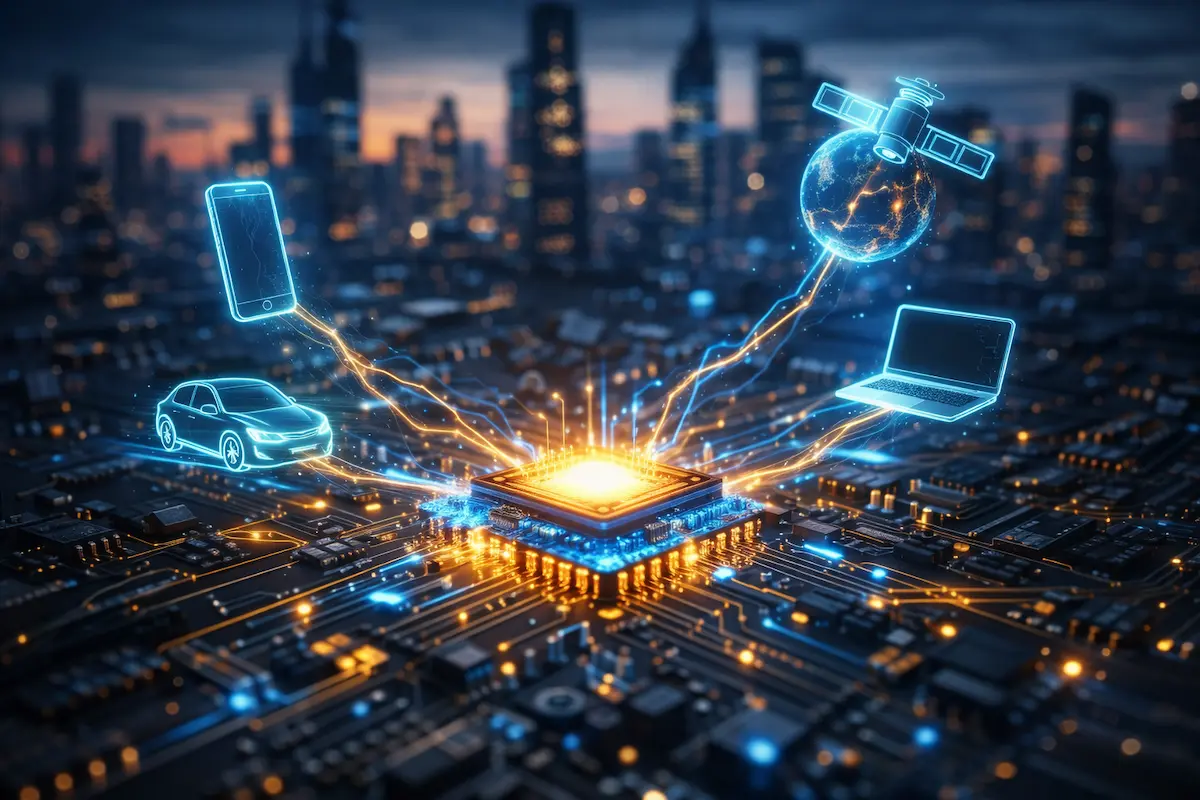
The true magic of these chips is their versatility. Here is how they drive the devices you use every single day.
1. Smartphones and Wearables
Your smartphone is essentially a supercomputer that fits in your pocket. The main chip inside (the System-on-Chip or SoC) contains the central processor, the graphics processor, and the modem for 5G internet. Because chips have become so small and efficient, we can now pack this immense power into smartwatches and fitness trackers without draining the battery in ten minutes.
2. Computers and Data Centers
Laptops and desktop computers rely on highly complex Central Processing Units (CPUs) to run software and operating systems. On a much larger scale, massive data centers use thousands of powerful chips to store the internet, run cloud services, and train Artificial Intelligence models.
3. The Automotive Industry
Modern cars are basically computers on wheels. A standard electric vehicle (EV) contains thousands of semiconductor chips. They manage the battery life, control the touchscreen dashboard, operate the anti-lock braking system (ABS), and power advanced features like self-driving sensors and cameras.
4. Smart Home Appliances
Even basic home items now use microchips. Your washing machine uses a chip to calculate the exact amount of water needed for a cycle. Smart refrigerators use them to monitor internal temperatures, and smart TVs use them to connect to your Wi-Fi and stream 4K video seamlessly.
Comparison Table: Types of Semiconductor Chips
Not all chips do the same job. Here is a quick breakdown of the different types of chips powering our world:
| Type of Chip | Main Function | Real-World Example |
| Logic Chips (CPUs/GPUs) | The “brains” that process data and solve complex tasks. | Computer processors, Smartphone chips |
| Memory Chips (RAM/ROM) | Store data temporarily or permanently. | Flash drives, phone storage, computer RAM |
| Analog Chips | Translate real-world signals (sound, light) into digital data. | Smartphone microphones, camera sensors |
| Power Management Chips | Regulate electricity flow to prevent overheating. | Fast chargers, laptop batteries |
The Incredible Journey: How Chips Are Manufactured
Knowing how semiconductor chips power modern electronics is fascinating, but understanding how they are built is mind-blowing. The manufacturing process is considered the most complex manufacturing process in human history.
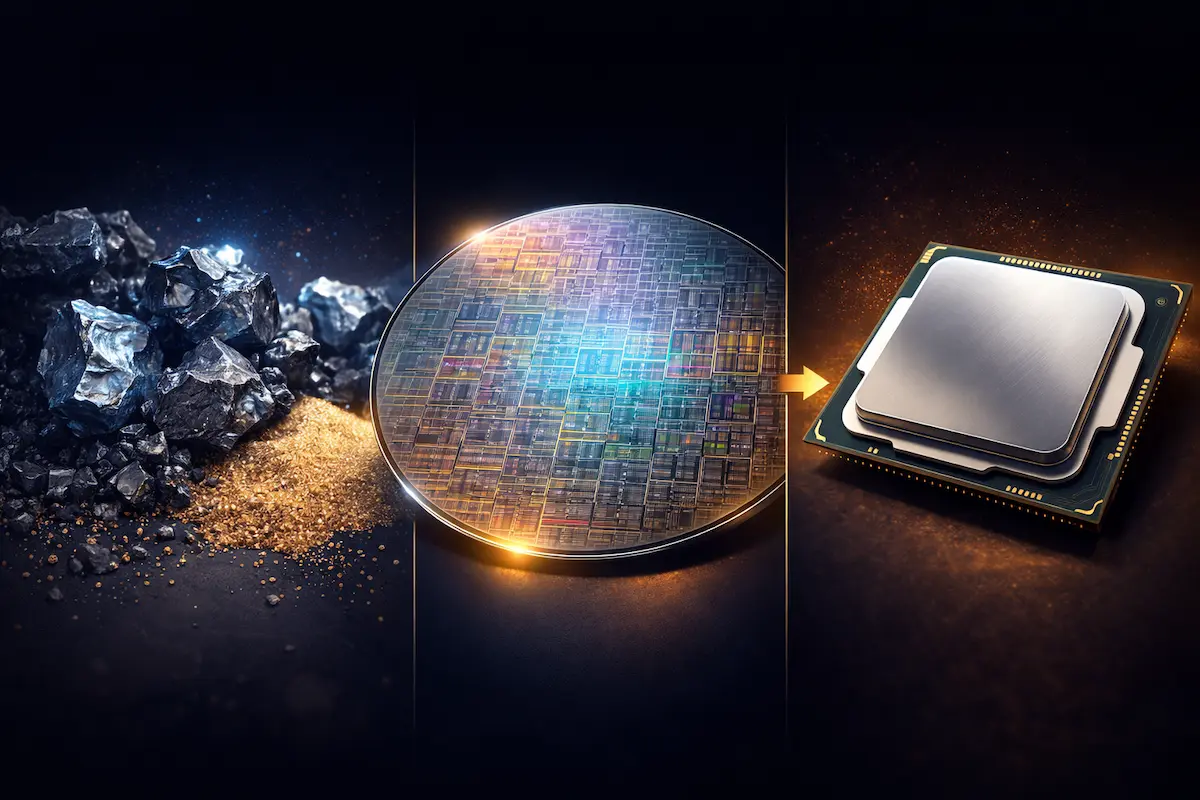
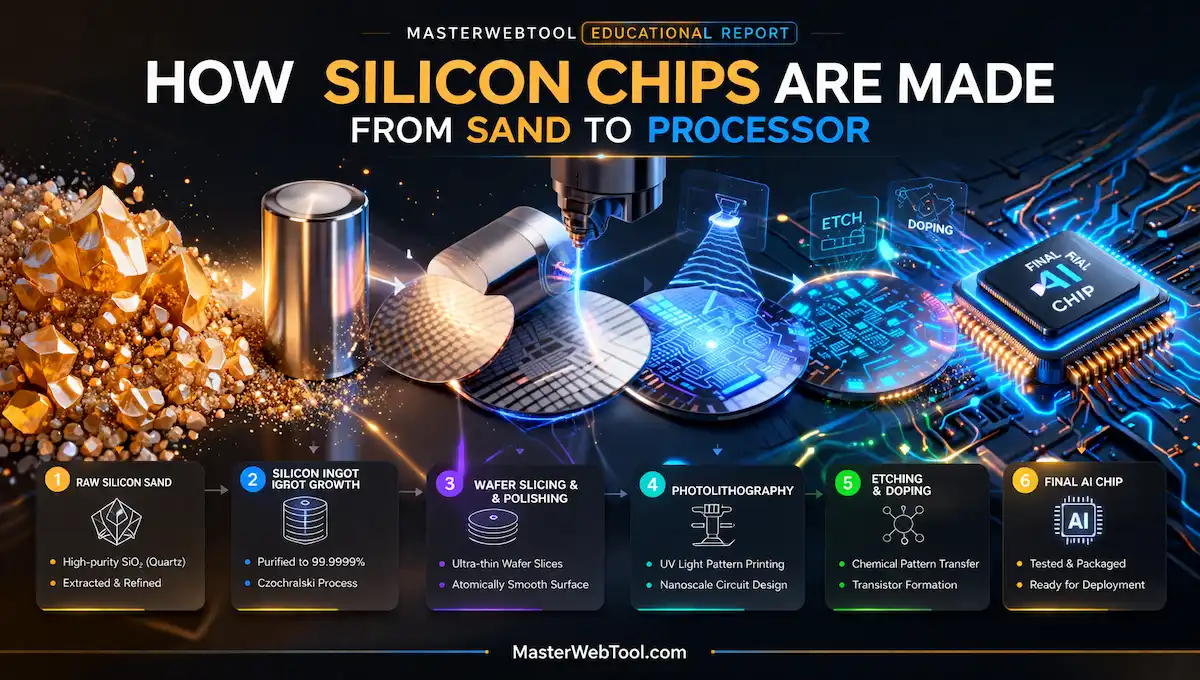
Purification: It starts with melting silica sand to create a cylinder of silicon that is 99.9999999% pure.
Wafer Slicing: This cylinder is sliced into incredibly thin discs called wafers.
Photolithography: In a room 10,000 times cleaner than an operating theater, a machine projects ultraviolet light through a blueprint (like a stencil) to print the microscopic circuits onto the silicon wafer.
Etching and Doping: Chemicals are used to carve out the circuits, and impurities are added to create the transistors.
Packaging: The wafer is cut into individual chips, which are placed into protective plastic or ceramic cases with tiny metal pins to connect to circuit boards.
To learn more about the massive companies that handle this complex process, check out our detailed guide on the Top Semiconductor Companies in the World.
(Note to reader: For external deep-dives into the physics of materials, you can always refer to the Institute of Electrical and Electronics Engineers (IEEE)components.
The Future of Semiconductors
As we look toward the future, the demand for processing power is only going up. With the rise of Artificial Intelligence, virtual reality, and autonomous vehicles, chips need to become even faster and consume less power.
Engineers are currently developing chips with 2-nanometer technology. To put that in perspective, a single strand of human hair is about 80,000 to 100,000 nanometers wide! Researchers are also exploring new materials beyond silicon, such as Graphene, which could revolutionize how electronics operate in the next decade.
Frequently Asked Questions (FAQ)
1. What is the main purpose of a semiconductor chip?
The main purpose is to process information. By controlling the flow of electricity through billions of microscopic switches (transistors), the chip performs the mathematical calculations required to run software, display images, and connect to networks.
2. Why are semiconductors made of silicon?
Silicon is used because it is abundant (found in sand), cheap to extract, and has the perfect chemical properties to act as both a conductor and an insulator when manipulated.
3. How long does it take to manufacture a microchip?
It can take anywhere from three to four months to manufacture a complex semiconductor chip. The process involves hundreds of precise steps inside highly controlled environments called cleanrooms.
4. What happens if a semiconductor gets too hot?
If a chip overheats, the materials can degrade, causing the transistors to fail. This leads to system crashes or permanent damage to the device. This is why computers and gaming consoles have internal fans and cooling systems.
5. Are microchips and semiconductors the same thing?
Generally, yes. A “semiconductor” refers to the material itself (like silicon), while a “microchip” or “integrated circuit” is the final product made from that material. In everyday conversation, the terms are used interchangeably.
Conclusion
Understanding how semiconductor chips power modern electronics gives us a profound appreciation for the devices we use every day. These tiny squares of silicon are the unsung heroes of the modern age. By manipulating the flow of electricity at a microscopic level, they turn raw power into the videos we watch, the messages we send, and the software that runs global industries.
As technology advances, these chips will only become more integrated into our lives, driving innovations we can barely imagine today.