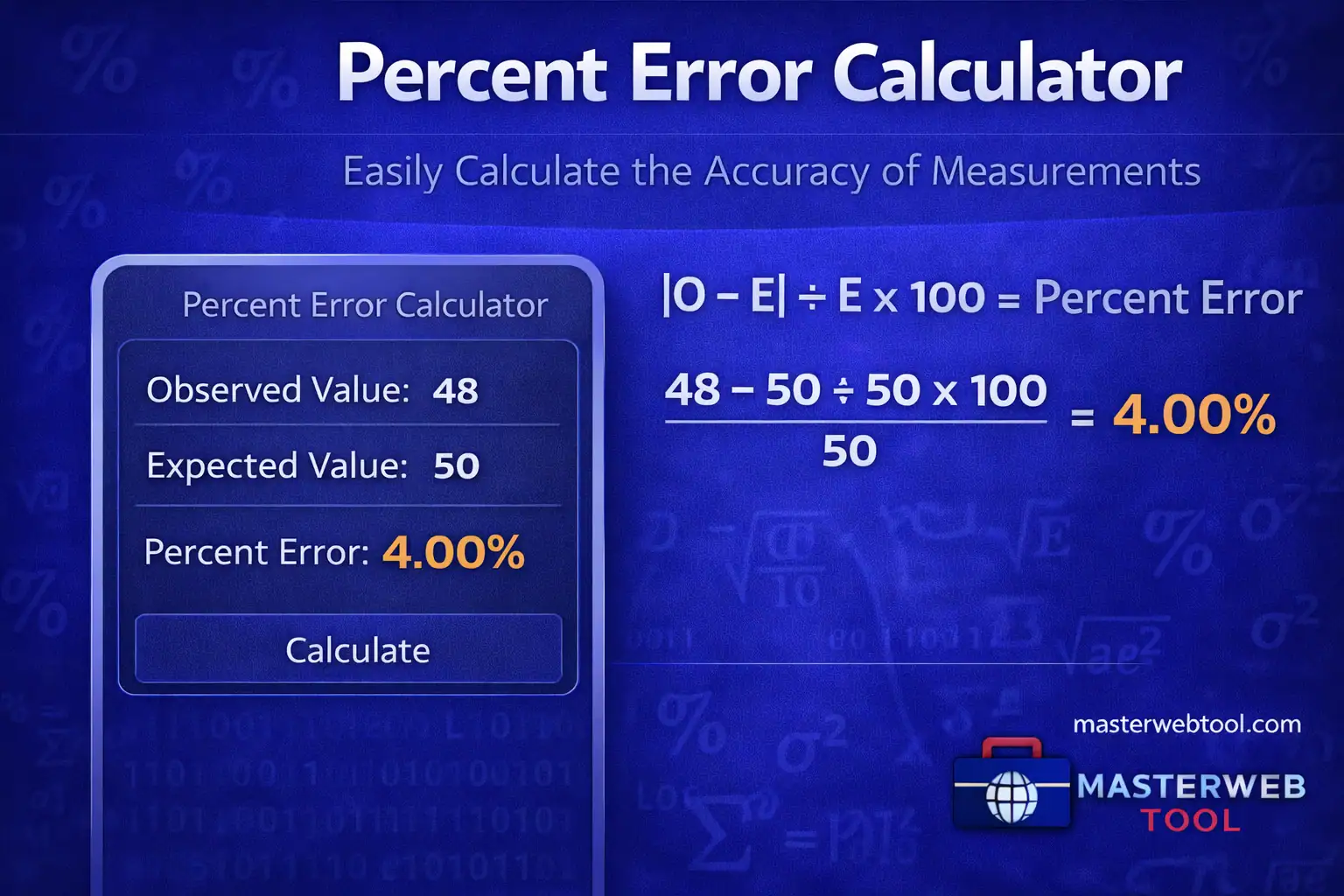
Percent Error Calculator Guide helps you measure how far an experimental or measured value deviates from the true or accepted value. Percent error is widely used in science, physics, chemistry, mathematics, engineering, and laboratory experiments.
This complete Percent Error Calculator guide explains what percent error is, why it matters, how to calculate percent error correctly, and how to use an online percent error calculator to save time and avoid calculation mistakes.
What Is Percent Error?
Percent error is a measurement of how inaccurate a value is compared to the accepted or true value. It shows the difference between the experimental value and the actual value as a percentage of the true value.
Percent error helps determine accuracy in measurements and experiments.
Why Percent Error Is Important
- Measures accuracy of experimental results
- Used in science labs and research
- Helps identify measurement errors
- Important in physics and chemistry experiments
- Improves understanding of data reliability
How a Percent Error Calculator Works
A Percent Error Calculator automatically applies the percent error formula using the experimental value and the accepted value to calculate the error percentage.
It provides instant and accurate results without manual calculation.
Percent Error Formula Explained
The standard percent error formula is:
- Percent Error = |Experimental − Accepted| ÷ Accepted × 100
Example:
If the accepted value is 50 and the experimental value is 47:
- |47 − 50| ÷ 50 × 100 = 6%
How to Use a Percent Error Calculator (Step-by-Step)
- Open the Percent Error Calculator tool
- Enter the experimental (measured) value
- Enter the accepted (true) value
- Click on the calculate button
- View the percent error instantly
Understanding Your Percent Error Result
A smaller percent error indicates higher accuracy, while a larger percent error means the measured value is farther from the accepted value.
Percent error can be positive or negative, but calculators often display the absolute value.
Percent Error vs Percent Difference
- Percent Error: Compares measured value to a true value
- Percent Difference: Compares two measured values
Percent error is used when a known correct value exists.
Who Should Use a Percent Error Calculator?
- Students and teachers
- Science and engineering students
- Laboratory researchers
- Physics and chemistry learners
- Anyone working with measurements
Common Mistakes in Percent Error Calculation
- Using wrong values (accepted vs experimental)
- Forgetting absolute value
- Dividing by the wrong number
- Manual calculation errors
Tips for Accurate Percent Error Calculation
- Always identify the accepted value correctly
- Use absolute value for error
- Double-check input values
- Use reliable online calculators
Related Calculator Tools
Calculate Percent Error Instantly
Use our free Percent Error Calculator to measure accuracy and analyze experimental results quickly and accurately.
Open Percent Error Calculator →Frequently Asked Questions (FAQ)
What is a Percent Error Calculator?
A Percent Error Calculator is an online tool that calculates the percent error between experimental and accepted values.
Is percent error always positive?
Percent error can be positive or negative, but most calculators show the absolute value to represent error magnitude.
Is an online Percent Error Calculator accurate?
Yes, it uses the correct mathematical formula and provides accurate results instantly.
Who can benefit from using a Percent Error Calculator?
Students, teachers, researchers, and professionals working with measurements can benefit from it.

Ravi Chand Yadav is the founder of MasterWebTool, focused on building fast, simple, and reliable online calculators and educational tools for students and professionals.