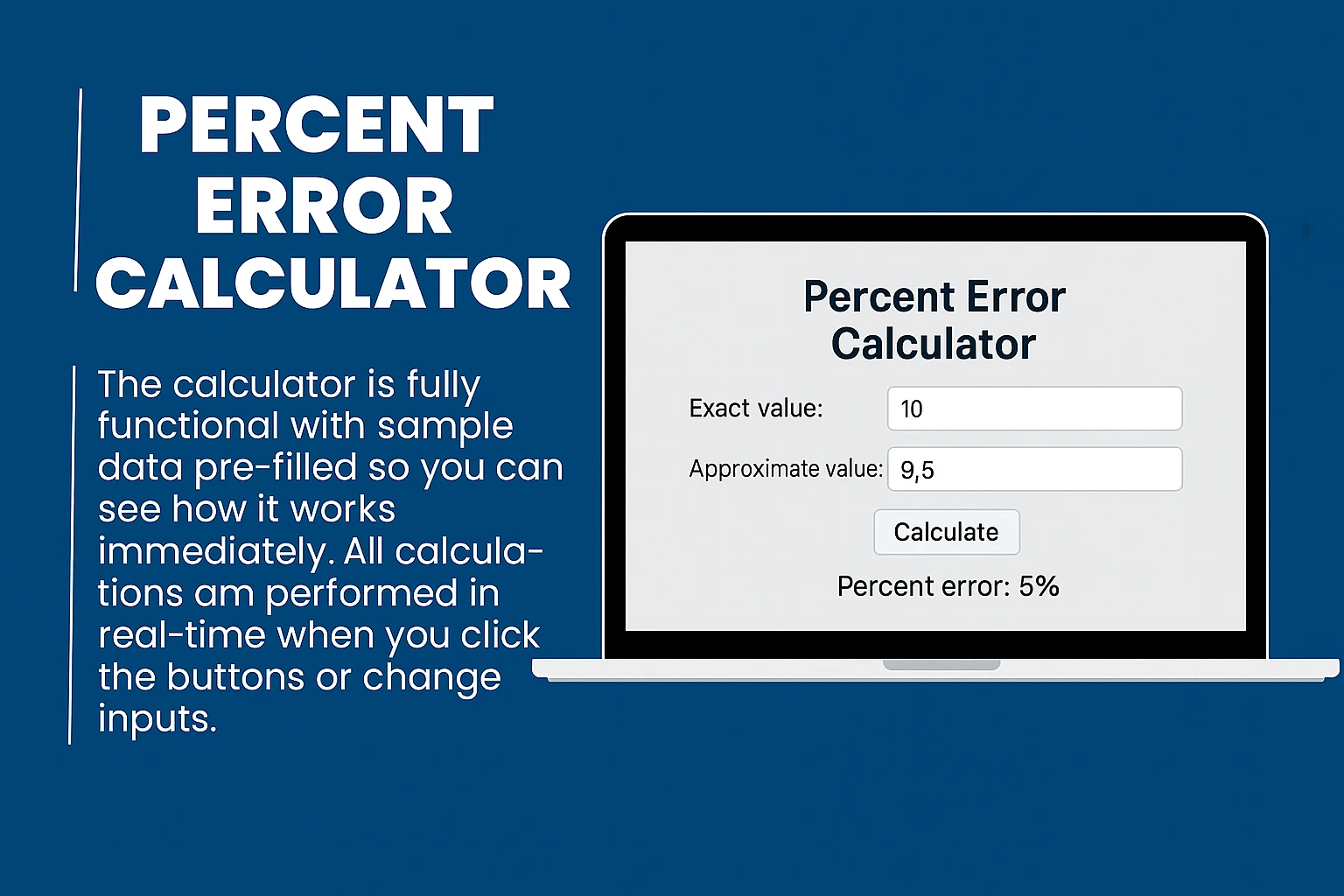
“Free Percent Error Calculator – quickly compare observed and expected values with step-by-step results.”
⚡ Percent Error Calculator
Calculate error and difference percentage with step-by-step logic.
📏 How to Use the Percent Error Calculator
Verify the accuracy of your experiments and measurements instantly.
The Percent Error Calculator is an essential tool for measuring the precision of an experimental or observed value compared to a known theoretical or true value.
It is widely used in science labs, chemistry, physics, and engineering to determine the margin of error between measured data and accepted standards. A low percent error indicates high accuracy, while a high percentage suggests potential issues in measurement or calculation.
- Measured Value: Enter the result you obtained from your experiment (Experimental Value).
- Theoretical Value: Enter the correct or accepted value you expected (True Value).
- Calculate: Click the button to see the percentage difference instantly.
- Reset: Clear all fields to start a new trial calculation.
Key Terms:
- Experimental Value: The value measured during a test.
- Theoretical Value: The “correct” value found in books or tables.
- Absolute Value (| |): We ignore negative signs because error is measured as a magnitude.
Understanding your percentage error helps assess the quality of your work:
- ✅ 0–5%: Excellent Accuracy – Ideal for most scientific labs.
- ⚠️ 5–10%: Acceptable – Some minor measurement variation exists.
- ❌ 10%+: Inaccurate – Significant errors in methodology or tools.
- Multi-Trial Analysis: Compare error trends across multiple experimental runs.
- Data Export: Save your lab summaries directly to PDF or Excel.
- Graphing: Visualize measurement deviations with interactive charts.
- Relative Error: Switch between absolute and relative error modes effortlessly.
💎 Upgrade to Percent Error Pro.
What Is a Percent Error Calculator?
A Percent Error Calculator is a tool used to measure how accurate an experimental or measured value is compared to the actual or accepted value. It shows the difference as a percentage, making it easy to understand the accuracy of results.
Understanding Percent Error
Percent error tells you how far your measured value is from the true value.
- Low percent error → High accuracy
- High percent error → Low accuracy
Percent Error = |Measured Value − Actual Value| ÷ Actual Value × 100
Why Use a Percent Error Calculator?
Manual calculations can be time-consuming and error-prone. This tool helps you calculate percent error quickly and accurately.
- ✔ Instant results
- ✔ Accurate calculations
- ✔ Saves time in exams and labs
- ✔ Useful for students and professionals
- ✔ Eliminates calculation mistakes
How to Use the Percent Error Calculator
- Enter the Measured Value (your result)
- Enter the Actual Value (true value)
- Click the “Calculate” button
- View your percent error instantly
Always use the absolute value (ignore negative sign) when calculating percent error.
Real-Life Example
Suppose the actual weight of an object is 50 kg, but your measurement shows 47 kg.
Calculation:
|47 − 50| ÷ 50 × 100 = 6%
This means your measurement has a 6% error.
Applications of Percent Error
- Science Experiments: Measure accuracy of results
- Engineering: Evaluate measurement precision
- Education: Solve physics and chemistry problems
- Manufacturing: Quality control analysis
A lower percent error indicates higher accuracy. In scientific experiments, minimizing percent error is essential for reliable results.
Related Educational Tools
Frequently Asked Questions
What is percent error?
Percent error shows how much your measured value differs from the actual value in percentage form.
Why do we use absolute value?
Because error represents magnitude, not direction, so negative signs are ignored.
What is a good percent error?
A smaller percent error is better because it indicates more accurate results.

Ravi Chand Yadav is the founder of MasterWebTool, dedicated to creating fast, simple, and reliable online calculators that help users solve real-life problems with accuracy and ease.