
If you are reading this article on a smartphone, working on a laptop, or even driving a modern car, you are relying on a tiny, invisible piece of technology: the semiconductor. For decades, the global supply of these microscopic brains has been controlled by a handful of countries. However, a historic shift is happening right now, and India is at the very center of it.
With Micron Technology’s massive investment in a new semiconductor plant in Sanand, Gujarat, India is no longer just a consumer of technology—it is rapidly becoming a global manufacturer. In this comprehensive guide, we will explore what this mega-project means for the Indian economy, how it will impact global tech supply chains, and why it matters to you as an everyday tech user.
What Exactly is Semiconductor Technology? (Explained Simply)
Before we dive into Micron’s mega-project, we need to understand what a semiconductor actually is.
Real-Life Tech Example: Think of a semiconductor like the “Traffic Controller” of a busy smart city. A traffic controller decides which cars move, which ones stop, and how fast the traffic flows. Similarly, a semiconductor chip controls the flow of electricity (data) inside your devices. Without this chip, your laptop’s screen wouldn’t turn on, your smartphone wouldn’t process apps, and modern web servers wouldn’t be able to host websites.
They are called “semi”-conductors because they can conduct electricity under certain conditions and block it under others. This unique ability allows them to process the binary code (0s and 1s) that powers the entire digital world.
Why Did Micron Technology Choose India?
Micron Technology, an American giant known for producing top-tier memory and storage chips, could have built their new plant anywhere in the world. So, why did they choose India? The decision is backed by three powerful reasons:
1. The ‘Make in India’ and PLI Push
Building a semiconductor plant is incredibly expensive. To attract global leaders, the Indian Government introduced a massive Production Linked Incentive (PLI) scheme. Out of the total $2.75 billion (approx. ₹22,500 crore) investment for the Micron plant, the Indian Central and State governments are providing roughly 70% of the funding in the form of incentives. This financial backing made India a highly attractive and secure destination for Micron.
2. A Massive Talent Pool of Tech Engineers
India has always been a software superpower, exporting IT services and web development talent across the globe. However, hardware manufacturing requires specialized engineers. India produces thousands of highly skilled electronics and mechanical engineers every year. Micron recognized this untapped talent pool, knowing they could build a world-class workforce locally without relying on expensive foreign talent.
3. De-risking the Global Supply Chain
For years, the world relied heavily on Taiwan and China for semiconductor manufacturing. When global events and pandemics disrupted these supply chains, the tech world panicked. Car manufacturing stopped, and laptop prices skyrocketed. Global tech companies realized they needed a “China Plus One” strategy to distribute their risk. India, with its stable democracy and growing tech infrastructure, emerged as the most reliable alternative.
Inside the Micron ATMP Plant in Sanand, Gujarat
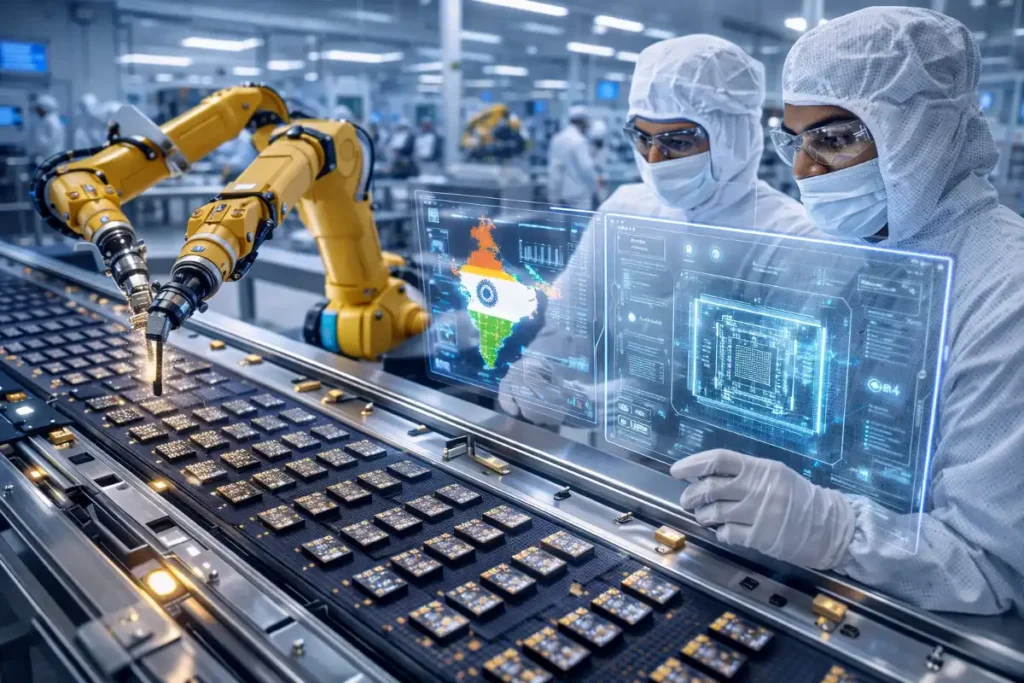
It is important to understand that Micron is not currently building a “Fab” (Fabrication) unit in India, which is where the raw silicon wafers are originally baked. Instead, they are building a state-of-the-art ATMP facility.
What does ATMP mean? It stands for Assembly, Test, Marking, and Packaging.
Real-Life Tech Example: Imagine building a high-performance web server. Buying the raw metal and wires is the first step (Fabrication). But assembling the motherboard, testing the RAM to ensure it doesn’t crash, putting the brand sticker on it, and safely packaging it for the data center is equally crucial. That is exactly what the ATMP plant does.
Raw memory chips will be imported to the Sanand facility, where highly advanced robots and Indian engineers will assemble them into finished products, rigorously test them for quality, mark them, and package them to be shipped globally to smartphone and laptop manufacturers.
How Micron’s Entry Will Transform the Indian Economy

The establishment of the Micron plant in Sanand is not just about a single company setting up a factory; it is about creating an entire technology ecosystem. The economic multiplier effect of a semiconductor plant is massive.
1. Massive Job Creation (Direct and Indirect)
A high-tech facility like this requires brilliant minds and skilled hands. Micron estimates that this ATMP plant will create up to 5,000 direct jobs for hardware engineers, data analysts, and technicians. But the real magic lies in the indirect jobs. It is estimated that up to 15,000 indirect jobs will be generated in logistics, construction, facility management, and security. It will transform Sanand into a thriving tech hub, similar to what Silicon Valley experienced in its early days.
2. Boosting Local Supply Chains and Ancillary Businesses
A semiconductor plant cannot operate in isolation. It needs hundreds of local vendors to supply chemicals, specialized packaging materials, safety equipment, and transport services. By sourcing these materials locally, Micron will help build a micro-economy around its plant, empowering Indian small and medium enterprises (SMEs) to upgrade their quality standards to meet global tech requirements.
Real-Life Impact: Why Micron’s Chips Matter to You
You might be wondering, “I am just a blogger, a student, or a web developer. How does a semiconductor plant in Gujarat affect me?” The answer lies in the devices you use every single day.
Micron specializes in DRAM (Dynamic Random Access Memory) and NAND flash storage.
Real-Life Tech Example: Think about opening a heavy, content-rich WordPress website. The speed at which your browser loads those high-resolution images and scripts depends entirely on the RAM and SSD storage of the web server hosting that site. If the server uses low-quality memory chips, the site will lag, ruining the SEO and user experience.
Micron makes the high-speed memory chips that go into these servers, as well as the SSDs inside your laptop and the RAM inside your smartphone. When these critical components are manufactured and packaged locally in India, the global supply chain stabilizes. This means in the future, when there is a global crisis, the prices of laptops, smartphones, and cloud hosting servers will not skyrocket like they did in 2021. Local production eventually leads to more affordable and easily available technology for everyone.
The Challenges Ahead for India’s Semiconductor Dream
While the future looks bright, the road to becoming a semiconductor superpower is not without its speed bumps. Building an ATMP plant is complex, and India must overcome a few critical challenges:
- Uninterrupted Power and Ultra-Pure Water: Semiconductor manufacturing is incredibly sensitive. A power cut of even a single second can ruin millions of dollars worth of chips. Similarly, the process requires millions of liters of “ultra-pure” water to wash the silicon. The government must ensure a 100% flawless supply of these resources.
- Highly Specialized Skilling: While India has great software developers, handling microscopic hardware components requires a different skill set. Engineering colleges and universities will need to update their curriculums to train students specifically for cleanroom environments and hardware testing.
Frequently Asked Questions (FAQs)
What is Micron Technology building in India? Micron Technology is building an advanced ATMP (Assembly, Test, Marking, and Packaging) semiconductor facility. This plant will import raw memory wafers, assemble them into finished chips, test them for quality, and package them for global distribution.
Where is the new Micron semiconductor plant located? The new facility is located in the Sanand Industrial Estate in Gujarat, India. This location was chosen due to its strong manufacturing infrastructure and supportive local government policies.
How many jobs will the Micron plant create in India? The project is expected to create up to 5,000 direct high-tech jobs and approximately 15,000 indirect jobs in the surrounding community over the coming years.
Will locally made semiconductors make electronics cheaper in India? While it may not cause an immediate price drop, localizing the supply chain protects the market from global shortages and import duties. Over time, as a larger ecosystem develops, this will lead to more stabilized and potentially lower costs for smartphones, laptops, and digital appliances in India.
Conclusion
The arrival of Micron Technology in India is a watershed moment. It marks the shift of the country from being solely the world’s “IT back-office” to becoming a critical hub for global hardware manufacturing.
Just like writing a perfect line of code requires patience and precision, building a semiconductor ecosystem takes time. However, the foundation has now been laid. As this plant becomes fully operational, it will empower Indian engineers, secure global tech supply chains, and ensure that the devices powering our future are securely, efficiently, and proudly “Made in India.”