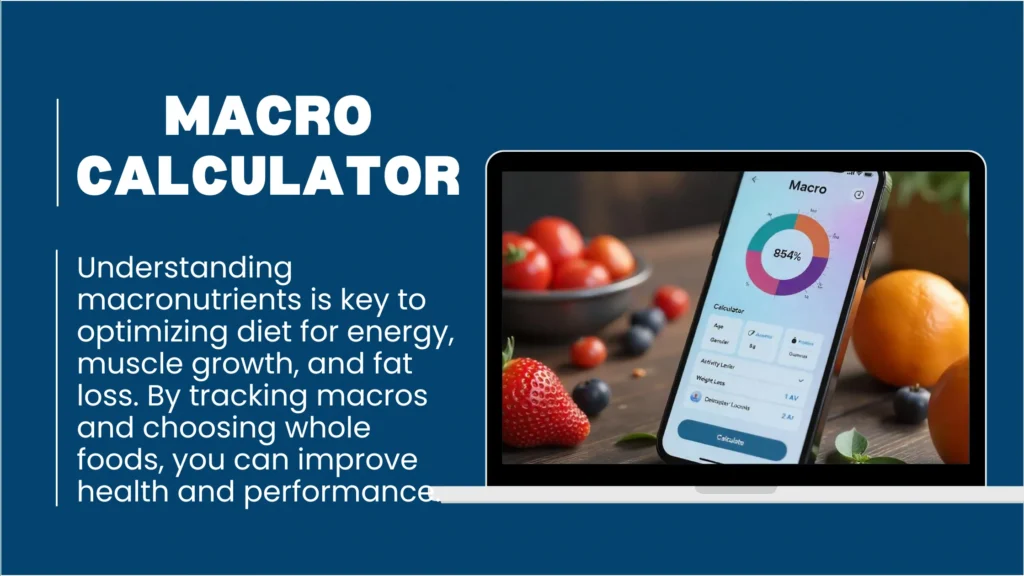
The Macro Calculator helps you determine the right balance of proteins, carbohydrates, and fats based on your age, gender, weight, height, and fitness goal. Use this tool to plan your diet for weight loss, muscle gain, or healthy maintenance with accuracy.
✦ Smart Online Tools for Faster Results
MasterWebTool provides fast, simple, and reliable online tools to help you complete everyday tasks with ease. From calculators to productivity tools, everything is designed to save time and improve accuracy.
Explore Free Tools →🥗 Macro Calculator
Calculate your daily protein, carb, and fat intake — visualize your macros with charts.
To calculate your daily calorie needs first, try our Calorie Calculator.
📗 How to Use the Macro Calculator
To get an accurate macro breakdown, fill in your details:
- Age, Gender, Height & Weight: These are used to calculate your baseline calorie needs.
- Activity Level: Be honest! This determines how many extra calories you burn daily.
- Goal: Choose whether you want to lose weight, maintain, or gain muscle.
Your daily calories will be split into three main categories (Macros):
- Protein (4 calories/gram): Essential for building and repairing muscle.
- Carbohydrates (4 calories/gram): Your body’s primary source of quick energy.
- Fats (9 calories/gram): Crucial for hormone health and nutrient absorption.
Different goals require different macro ratios. Common examples include:
- Balanced Diet: 40% Carbs, 30% Protein, 30% Fat
- High Protein (Muscle Building): 30% Carbs, 40% Protein, 30% Fat
- Low Carb (Fat Loss): 20% Carbs, 40% Protein, 40% Fat
The Ultimate Guide to Macronutrients (Macros)
If you want to take total control of your body composition, just counting calories isn’t enough. You need to understand Macronutrients (Macros). While calories determine how much weight you lose or gain, macros determine what kind of weight you lose or gain (fat vs. muscle).
Calories vs. Macros: What’s the Difference?
Think of calories as the total budget for your day, and macros as how you spend that budget. Your total calorie intake dictates weight changes, but your macro split dictates how your body looks and functions.
• 1 gram of Protein = 4 Calories
• 1 gram of Carbohydrates = 4 Calories
• 1 gram of Fat = 9 Calories
Real-Life Example: Why Macros Matter
Let’s look at two people eating exactly 2,000 calories a day.
Person A gets their 2,000 calories mostly from pizza and soda (High Carb, High Fat, Low Protein). They might not gain weight, but they will likely feel sluggish, lose muscle, and gain body fat (becoming “Skinny Fat”).
Person B gets their 2,000 calories from chicken, rice, and healthy oils (High Protein, Moderate Carbs, Moderate Fat). They will build muscle, burn fat, and have consistent energy throughout the day.
This is why hitting your macro targets is the secret to a great physique!
Always prioritize your Protein target first. Protein is the hardest macro to hit accidentally, but it is the most important for muscle preservation and keeping you feeling full. Once your protein is set, you can be more flexible with your carbs and fats.
Common Mistakes When Tracking Macros
- Ignoring Food Quality: Just because a donut fits your macros doesn’t mean it’s good for your health. Micronutrients (vitamins and minerals) still matter!
- Not Weighing Food: “A handful of nuts” could be 15g of fat or 40g of fat. Always use a digital kitchen scale for accuracy.
- Stressing Over Exact Numbers: Being over or under by 5-10 grams won’t ruin your progress. Consistency is more important than perfection.
Related Fitness Tools
Frequently Asked Questions
Are macros more important than calories?
No, calories are the foundation of weight management. If you eat 4,000 calories of “perfect macros,” you will still gain weight. Macros optimize the results of your calorie intake.
How often should I adjust my macros?
You should re-calculate your macros whenever your body weight changes significantly (e.g., losing or gaining 5-10 lbs) or if your primary fitness goal changes.